
Micro-Dramas: India's Fastest-Growing Screen, and How Brands Should Use It
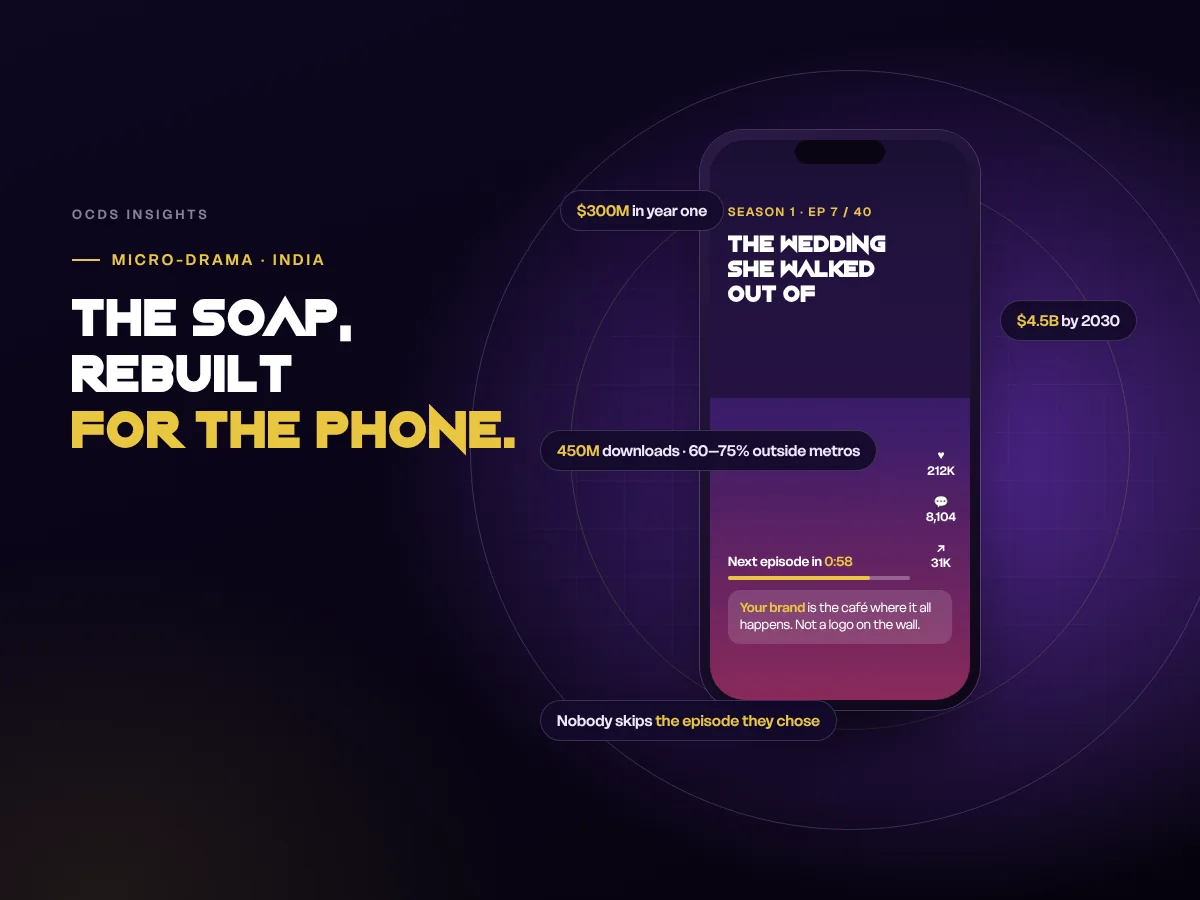
Sixty-second episodes. A cliffhanger every minute. A season you finish on a train ride. Micro-dramas are the television soap rebuilt for the vertical phone screen, and in India they have become a business faster than almost any content format before them.
The numbers are startling for a category this young. Micro-drama platforms generated $300 million in their first year and are projected to reach $4.5 billion by 2030, with 91% growth expected in 2026. RedSeer tracked the category doubling from roughly $125 million in annual recurring revenue in September 2025 to about $260 million by November 2025. India became the largest market globally for short-drama app downloads, recording over 21 million installs in a single month, and Lumikai estimates the category has crossed 450 million cumulative downloads.
Why India took to it so quickly
The format did not have to teach anyone anything. For Indian audiences steeped in serialised storytelling, micro-dramas are a mobile-native evolution of the TV drama. The daily soap already trained a generation to return for the next twist; the phone simply removed the schedule.
It is also not a metro phenomenon. The segment, valued at ₹650 crore in 2025, is forecast to compound at more than 50% a year through 2028, and 60 to 75% of its users already sit outside the biggest cities. The big platforms have noticed: JioHotstar is experimenting with Tadka, a dedicated micro-drama feature with over 100 vertical-format shows, and Zee5, MX Player, Hoichoi and ShareChat have all floated micro-drama apps.
What brands are doing with it
The interesting shift is from buying a slot to being in the story. Zomato, Ajio and Myntra have moved away from the 30-second spot toward soap-opera-style micro-dramas, and brands from JK Super Cement to Meesho, RuPay, Tinder and P&G are moving beyond product placement, betting on serialised storytelling to build deeper engagement with mobile-first audiences.
The logic is simple. If the skip button is the enemy, micro content gives brands a way around it: nobody skips the episode they chose to watch.
A word of caution
Audiences are arriving faster than the money. Pocket FM shut down Pocket TV, its vertical micro-drama platform, and analysts warn that content fatigue looms as every platform floods the feed with the same revenge-and-romance plots. The brands that win will not be the ones that sponsor the most episodes. They will be the ones whose story is worth a second episode.
How we approach it at OCDS
Start with the character, not the product. A brand that becomes a character's habit, workplace or turning point is remembered. A logo on a wall is not.
Write for the minute. Every episode needs a hook in the first three seconds, a reveal by the thirtieth and a reason to tap "next". That is a writing discipline, not an editing trick.
Make it in a language, not for India. The audience is in Tier 2 and Tier 3 towns and watches in Hindi, Marathi, Gujarati, Tamil and Bengali. One script localised five times beats one Hinglish script pushed everywhere.
Build an IP, not a campaign. A ten-episode series the brand owns can run on the micro-drama apps, on Reels and Shorts, and on the brand's own channels, and come back for a second season.
Measure like entertainment. Completion rate, episode-to-episode retention and the share of viewers who return decide whether the story worked; reach alone does not.
Micro-dramas are where India's attention is moving next. For a brand, that is a rare chance to be part of what people choose to watch, rather than the thing they wait to skip.
Related: OCDS verticals · Film and video production