
Why India's FMCG Giants Are Leaving TV for Creators, and What Growing Brands Should Copy
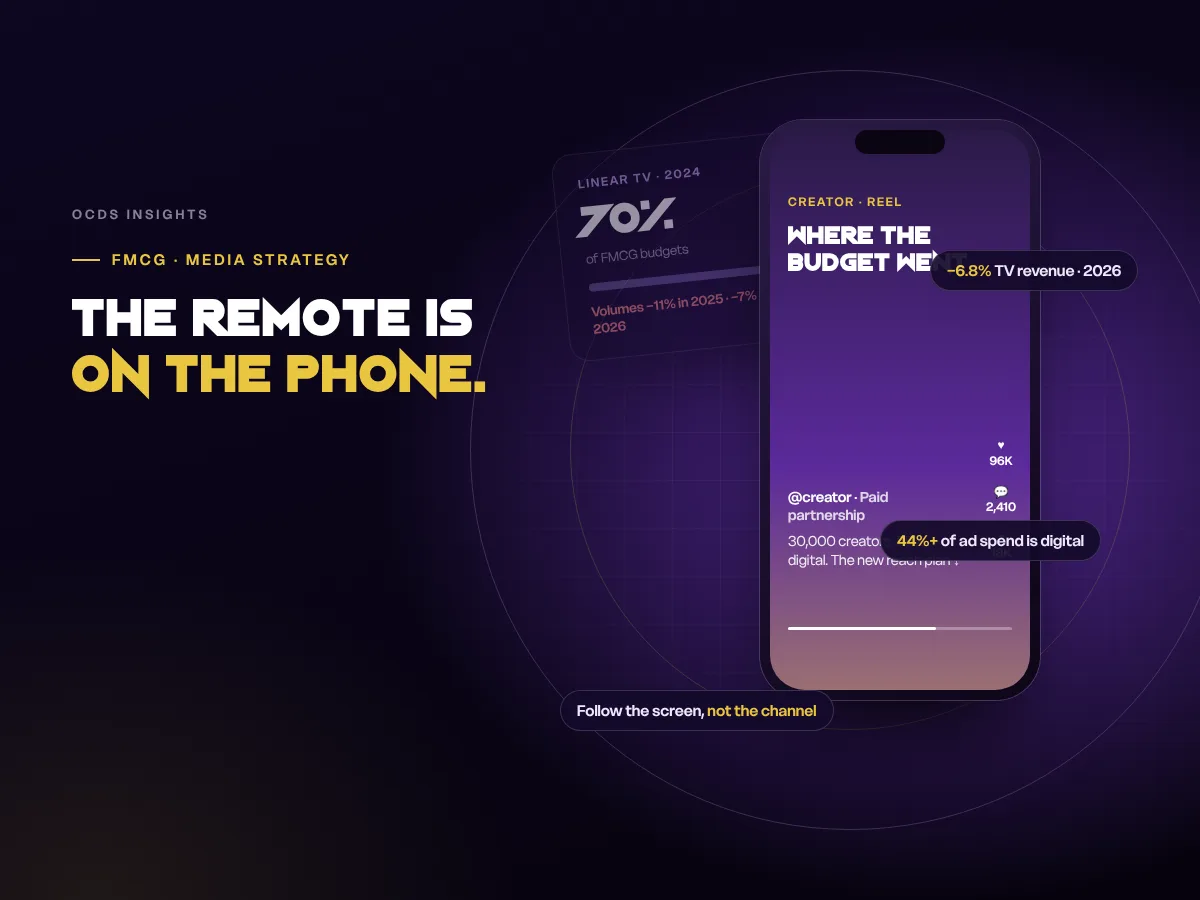
For thirty years the FMCG media plan in India began with television and ended with whatever was left. That era is closing, and it is closing fast. The country's biggest advertisers, the ones who taught the industry how to buy TV, are moving their money to creators, connected screens and the quick-commerce storefront. This piece lays out what the numbers say, why it is happening, and what a brand without an HUL-sized budget should take from it.
What the data says
Start with the scale of the shift. India's FMCG majors kept 70% of their budgets on television until 2024. Since then the slide has been steady: FMCG's television spends fell 4% in 2025, overall TV ad volumes fell 11% that year and a further 7% between January and July 2026. The forecasters have priced it in: WPP Media's mid-year 2026 report projects India's total television advertising revenue to fall 6.8%, to roughly ₹43,600 crore.
Zoom out a decade and the picture is starker. TV's share of Indian ad spend fell from 39.2% in 2015 to about 21% in 2025, while digital rose from 11.6% to more than 44%. The broadcasters feel it directly: Zee's FY26 annual report records linear TV ad revenue down 9% while connected TV grew 42%, and the company's own ad revenue fell 10% in the year.
Where the money is going
The brands are not spending less so much as spending elsewhere. HUL has doubled its influencer ecosystem to 30,000 creators, while Marico now allocates 55% of its core ad spend to digital channels. Emami and Nestlé India now put more than half of their ad budgets into digital media, and these are century-old names, not challenger brands with nothing to lose.
The destination is not just social feeds. FMCG brands are pushing digital budgets straight onto quick-commerce storefronts, placing ads at the digital point of sale, and the broader signal is major consumer brands shifting TV budgets into connected TV, creators and retailer media. Marketers are voting the same way in surveys: 94% of Indian marketers plan to increase spending on sponsorships and events over the next 12 to 24 months, and 81% rate influencer and creator content as highly effective, per Nielsen.
The uncomfortable part: TV still works
Here is the twist that makes this a strategy question rather than a stampede. Fresh econometrics from the UK, cited in this week's BestMediaInfo analysis, found that TV delivers 75.7% of the advertising-driven profit of big FMCG brands from 66.5% of their media spend, making it the only medium measured that returns more profit than its share of budget.
So the brands are not leaving TV because it stopped persuading. They are leaving because the audience is leaving: premium video demand has deserted broadcast grids for streaming, programmatic connected TV and ultra-short formats. A medium that converts brilliantly but reaches fewer households each quarter is a medium you buy with precision, not by default.
Five moves for a brand without an HUL budget
1. Buy creators as reach, not as a side dish. HUL did not add 30,000 creators as an experiment; it is replacing the frequency TV used to give. A mid-size brand should plan creator reach the way it once planned GRPs: by audience, by language, by week, with a frequency target.
2. Follow the screen, not the channel. The TV set is still in the room; it is just running YouTube, JioHotstar and connected-TV ads. Connected TV lets a regional brand buy the living room in Nagpur or Nashik without paying for the whole country.
3. Put the ad where the thumb is. If the product is bought on Blinkit, Instamart or Zepto, the storefront is the new shelf and the new ad slot. Quick-commerce media is the closest thing to point-of-sale advertising digital has ever offered.
4. One idea, every channel. The brands losing most in this shift are the ones that produce a TV film, then "adapt" it badly for everything else. Write the idea for the vertical phone first; a 30-second cut-down can follow.
5. Measure profit and households, not impressions. The UK data is a reminder that the right question is "which rupee returned the most profit", not "which channel is cheapest". Build the measurement before you move the money.
How we read it at OCDS
The shift is not TV versus digital. It is a reach plan being rebuilt around where attention actually lives, and the biggest advertisers in the country have just shown everyone the direction. For a growing brand the opportunity is unusual: the tools the giants are moving to, creators, connected TV, quick-commerce placements and short vertical film, are the ones a smaller budget can use with real precision. OCDS plans and produces that mix in-house, from the creator roster to the reels, so the idea survives the journey from the brief to the thumb.
Related: Influencer marketing by OCDS · Integrated campaigns